SPADE
SPaT Attack Detection and Evaluation dataset
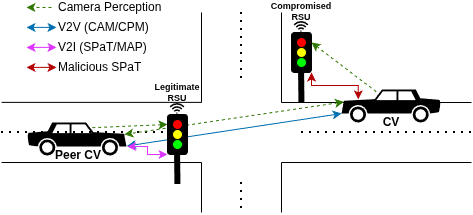
SPADE Threat Model: Attack Classes, Targeted SAE J2735 Fields, and Observable Multi-Modal Signatures
| Class | J2735 Field(s) | Observable Signature |
|---|---|---|
| BENIGN | N/A | All streams consistent; camera–SPaT agreement holds |
| FALSE_STATE | MovementPhaseState | Reported phase contradicts camera detection |
| REPLAY | Full SPaT msg | Stale phase/timer; timestamp inconsistent with clock |
| TIMING_MANIP | MinEndTime, MaxEndTime | Phase matches camera; countdown deviates from elapsed time |
| SYBIL | Source ID, V2V msg | Peer consensus fails; conflicting phase perception reports |
| DOS | N/A (suppression) | Inter-message interval exceeds expected broadcast period |
| IMPERSONATION | IntersectionID, source address | Source mismatch with known RSU identity |
Note: DoS is modeled as application-layer message suppression, observable as the absence of SPaT broadcasts within the expected reception window.
SPADE Feature Set: SPADE Data Records (40)
Vehicle Data Record (11)
| Feature | Description |
|---|---|
| vehicle_id | ID of the current vehicle |
| route_id | Route which the vehicle is traveling |
| lane_id | Current lane index of the vehicle |
| is_parked | Is the vehicle currently in a parked state |
| position | Latitude and longitude of the vehicle |
| heading | Vehicle’s current heading |
| speed | Current vehicle speed |
| throttle | Amount of throttle applied |
| brake | Amount of brake applied |
| longitudinal_accel | Amount of longitudinal acceleration |
| slope | Current slope the vehicle is on |
CAM Data Record (5)
| Feature | Description |
|---|---|
| vehicle_id | ID of the transmitting vehicle |
| message_time | Time the message was sent |
| position | Current transmitting vehicle position |
| distance | Distance between vehicles |
| vehicle_awareness | Transmitting vehicle proprioceptive data points |
TL Perception Data Record (10)
| Feature | Description |
|---|---|
| signal_id | ID of the perceived traffic signal |
| incoming_lane | Lane which precedes the signal |
| distance | Distance from current vehicle to signal |
| angle_off_center | Angle off center of camera |
| signal_red | Red one hot |
| signal_yellow | Yellow one hot |
| signal_green | Green one hot |
| camera_conf | Perception confidence level |
| cur_vis_score | Current visibility score |
| conf_vis_weighted¹ | Confidence level weighted with visibility |
Shared TL Perception Data Record (3)
| Feature | Description |
|---|---|
| vehicle_id | ID of the transmitting vehicle |
| vehicle_pos | Position of the transmitting vehicle |
| signal_perceptions | List of perceived signals (TL Percep. records) |
MAP Data Record (6)
| Feature | Description |
|---|---|
| message_time | Time the message was sent |
| intersection_id | ID of the intersection |
| lane_id | The intersection lane being referenced |
| lane_attributes | Lane properties (direction, type, shared) |
| lane_connections | Connected lanes (ex. u-turn, left, straight) |
| position | Latitude and longitude of the intersection |
SPaT Data Record (5)
| Feature | Description |
|---|---|
| signal_id | ID of this individual signal |
| message_time | Time the message was sent |
| signal_state | Current signal state |
| max_end_time | Maximum length of the current state |
| min_end_time | Minimum length of the current state |
¹ conf_vis_weighted = camera_conf × cur_vis_score
Scenario Configurations
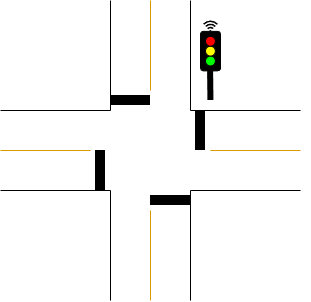 (a) 2-LANE
|
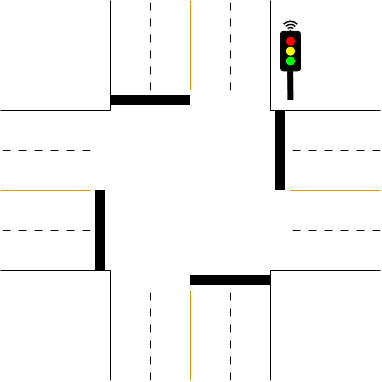 (b) 4-LANE
|
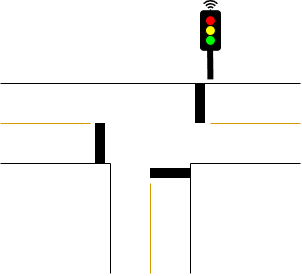 (c) T-CROSS
|
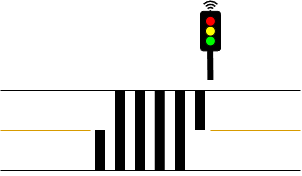 (d) PXO
|
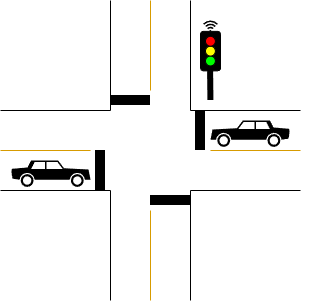 (e) LOW-DEN
|
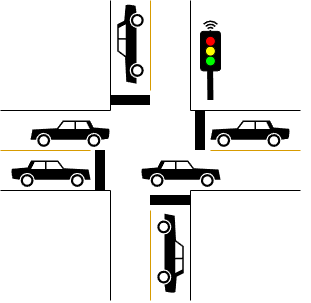 (f) HIGH-DEN
|
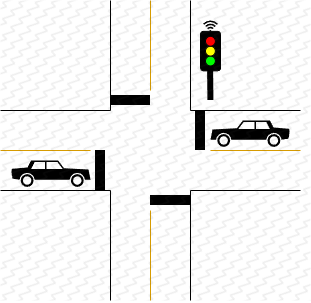 (g) HIGH-VIS
|
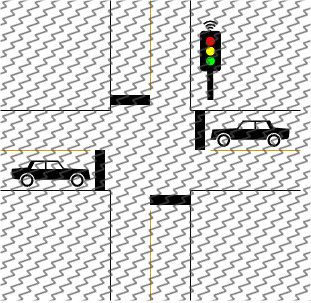 (h) LOW-VIS
|
The eight simulation scenario configuration types shown for SPADE. Note that there is a traffic signal for every stop line, however only one is shown in each configuration example. Row 1 (3a–3d): intersection and mid-block crossing geometry types derived from OSM exports. Row 2 (3e–3h): representative extremes of the two operating condition dimensions — traffic density (LOW-DEN and HIGH-DEN) and camera visibility (clear HIGH-VIS and heavily degraded LOW-VIS). The full configuration matrix also includes MED-DEN and MED-VIS as intermediate levels: 4 × 3 × 3 = 36 base configurations, each repeated with five random seeds, yielding 180 unique scenario runs.